
Hanoi Rental Contract Guide for Foreigners: What Expats Should Check Before Signing
16 June, 2026

Renting a home in Hanoi can be exciting, but the rental contract is where your experience truly becomes secure — or stressful. A beautiful apartment in Tay Ho, Ba Dinh, Hoan Kiem, Ciputra, Starlake, or the Diplomatic Corps area may look perfect during the viewing, but the details written in the lease agreement will decide how smooth your stay really is.
As a real estate rental advisor working with international tenants in Hanoi, I always tell expats one thing: do not treat the contract as a formality. A proper rental contract protects your deposit, clarifies your monthly costs, prevents misunderstandings with the landlord, and helps you complete temporary residence registration correctly after moving in.
This Hanoi rental contract guide for foreigners explains exactly what to check before signing, how the process works, and which clauses matter most.
For many foreigners, renting in Hanoi feels more flexible than in their home country. Negotiations can be fast, landlords may be friendly, and some homes are ready for immediate move-in. That flexibility is useful, but it can also create risk if the contract is too vague.

A good rental contract should clearly answer these questions:
Who is the legal landlord or authorized representative?
What exactly is included in the rent?
How much deposit is required, and when will it be refunded?
Who pays for management fees, internet, electricity, water, cleaning, parking, and repair costs?
What happens if either side wants to terminate early?
What is the handover condition of the apartment, villa, or house?
Who supports temporary residence registration for the foreign tenant?
If the contract does not answer these questions clearly, the tenant may face problems later — especially when moving out or requesting the return of the security deposit.
Yes. Foreigners can rent residential property in Hanoi as long as they have valid entry and stay documents, such as a passport and visa, e-visa, temporary residence card, or other lawful entry document.
Foreign tenants do not need local household registration to sign a housing rental contract. However, after moving in, temporary residence must still be declared with the local authority through the accommodation provider or landlord. This is an important distinction: signing the lease and registering temporary residence are two separate steps.
Common property types foreigners rent in Hanoi include:
Apartments in Tay Ho, Ba Dinh, Hoan Kiem, Ciputra, Starlake, Vinhomes Metropolis, Lancaster, and the Diplomatic Corps area
Serviced apartments for short- and mid-term stays
Villas and houses for families, embassy staff, executives, and long-term expats
Office-apartment or mixed-use units, depending on building rules and permitted use
Before signing, make sure the property is legally available for residential use and suitable for foreigners to stay.
Before signing an apartment rental contract in Hanoi, foreign tenants usually need to prepare:
A valid passport copy
A valid visa, e-visa, work permit, temporary residence card, or entry approval document
Company information, if the lease is paid by an employer
Personal contact details in Vietnam
Expected move-in date and lease term
Special requirements, such as pet permission, invoice support, parking, furniture changes, or early termination flexibility
If the tenant is a company or embassy, the landlord may also request company registration documents, tax information, or an authorized signatory letter.
A professional Hanoi lease agreement for foreigners should be written clearly, ideally in both English and Vietnamese. If there is any difference between the two versions, the contract should state which language version prevails.
At minimum, the contract should include the following sections.
The contract must identify the landlord and tenant clearly. For the landlord, check full name, ID/passport number, address, phone number, and legal ownership or authorization. For the tenant, include full name, passport number, nationality, and contact information.
If someone signs on behalf of the owner, request a valid authorization document.
The contract should describe the property accurately, including:
Full address
Apartment number, tower, floor, or villa/house number
Usable area
Number of bedrooms and bathrooms
Furniture and appliances included
Parking rights, if any
Private and shared areas
Building rules or residence regulations
Never rely only on verbal promises. If the landlord agrees to add furniture, replace appliances, repaint walls, install curtains, or allow pets, write it into the contract.
Most long-term rental contracts in Hanoi are 12 months. Some landlords accept 6-month contracts, especially for serviced apartments. Villas and high-end houses may require longer terms.
The contract should state:
Start date
End date
Move-in date
Renewal option
Notice period before renewal or termination
Whether rent can change upon renewal
A fair contract should also explain what happens if the tenant needs to leave early because of job relocation, visa issues, or family reasons.
The rental price should be clear and practical. In Hanoi, many listings are marketed in USD for easy comparison, but contracts and payments should be handled carefully in Vietnamese Dong where required.
The contract should state:
Monthly rent
Payment currency
Exchange rate method, if the rent is referenced in USD
Payment date
Payment frequency: monthly, quarterly, or semi-annually
Bank transfer details
Whether bank fees are paid by tenant or landlord
Late payment rules
Whether rent includes VAT or personal tax obligations, if relevant
For expats whose company pays the rent, clarify invoice support before signing. Some landlords can provide proper invoices; others cannot. This affects corporate leasing and reimbursement.
The security deposit is one of the most important parts of any rental contract in Hanoi. For apartments, the deposit is commonly one to two months’ rent. For villas, houses, or luxury properties, the deposit can be higher depending on lease term, furniture value, and negotiation.
The contract should explain:
Deposit amount
Payment deadline
Purpose of the deposit
When the deposit will be returned
Which deductions are allowed
Required move-out condition
Whether unpaid utilities can be deducted
Whether early termination causes deposit forfeiture
A tenant-friendly contract should not allow the landlord to keep the deposit for vague reasons. Deductions should be based on actual unpaid rent, unpaid bills, missing items, or damage beyond normal wear and tear.
Many disputes happen because tenants assume something is included when it is not. Your contract should clearly list who pays for:
Electricity
Water
Internet
Cable TV
Building management fee
Cleaning service
Drinking water
Parking
Gym or pool access
Pest control
Garbage collection
Minor repairs
Major repairs
Air-conditioner cleaning
Appliance maintenance
For apartments, ask whether the management fee is included in the rent. For villas or houses, check gardening, pool maintenance, security, and waste collection fees.
A proper rental contract in Hanoi should separate minor repairs from major repairs.
Usually, the landlord is responsible for structural issues, major appliance failure not caused by tenant misuse, water leakage, electrical system problems, and serious defects affecting normal use.
The tenant is usually responsible for damage caused by misuse, lost keys/cards, broken items due to negligence, and routine daily care.
The contract should include:
Response time for urgent repairs
Who contacts building management
Who pays for replacement parts
Whether the tenant can arrange repair and deduct cost if the landlord delays
Air-conditioner cleaning schedule
Pest control responsibility
Emergency access rules
This clause matters because Hanoi’s climate is humid, and problems such as mold, air-conditioner drainage, water leakage, and electrical issues can happen if maintenance is ignored.
Here is the practical process I recommend for foreign tenants.
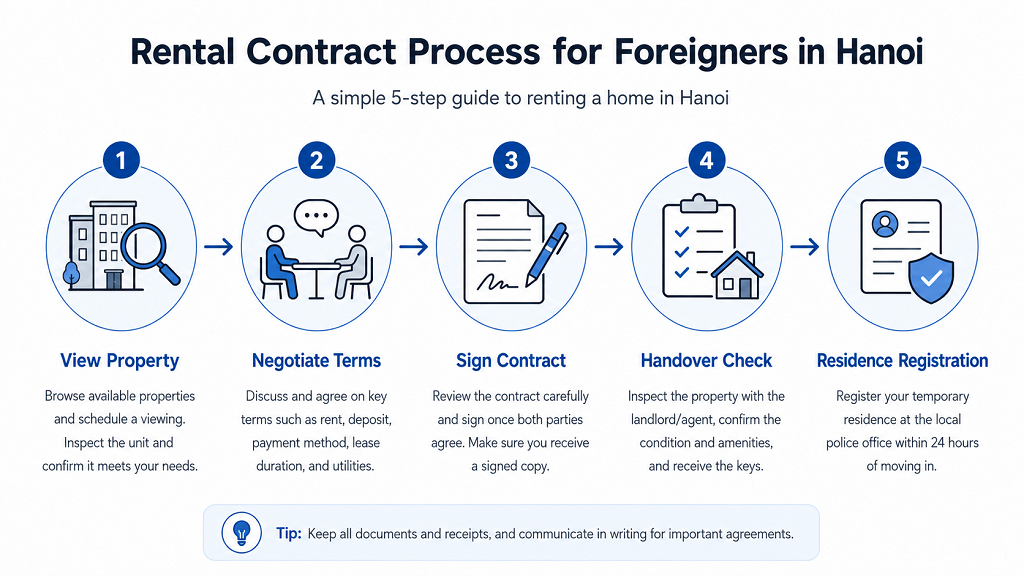
Before viewing homes, define your budget, preferred districts, lease term, furniture needs, pet policy, school or office commute, and whether you need invoice support.
This saves time and prevents you from falling in love with a property that does not match your legal or practical requirements.
During the viewing, check natural light, noise, water pressure, air-conditioning, mattress quality, kitchen equipment, balcony safety, building access, parking, and distance to shops or transport.
For families, check safety around windows, balconies, stairs, pool areas, and playgrounds.
Before paying any deposit, confirm who owns the property or who is legally authorized to lease it. If the person signing is not the owner, request authorization.
For apartments, also check whether the building allows foreign tenants, pets, short-term stays, or company leases.
Important terms should be agreed before the contract is drafted:
Rent
Deposit
Payment schedule
Furniture requests
Repairs before move-in
Lease term
Move-in date
Early termination clause
Notice period
Invoice support
Pet permission
Temporary residence registration support
Do not leave sensitive points for “later discussion.” Later usually means weaker negotiating power.
Read every clause carefully. Pay special attention to deposit refund, early termination, repair responsibilities, management fees, taxes, and handover condition.
For foreign tenants, a bilingual English-Vietnamese contract is strongly recommended. If the contract is only in Vietnamese, ask for a proper English version before signing.
At handover, take photos and videos of the property. Record the condition of walls, floors, furniture, appliances, bathroom fixtures, kitchen equipment, keys, access cards, parking cards, and utility meters.
Attach a furniture inventory and handover minutes to the contract.
This is one of the best ways to protect your deposit.
Use bank transfer whenever possible. Keep proof of payment for the deposit, rent, and any service fees. Avoid paying large amounts in cash without a signed receipt.
The payment receipt should state the amount, date, purpose, property address, and names of both parties.
After moving in, the landlord or accommodation provider should support temporary residence registration. This is important for visa extensions, temporary residence card applications, police checks, work procedures, and general compliance.
Ask the landlord to confirm once the declaration is completed.

Before accepting the property, check the following:
All keys, magnetic cards, parking cards, and mailbox keys
Electricity and water meter readings
Internet connection and Wi-Fi password
Air-conditioners in all rooms
Washing machine and dryer
Refrigerator and freezer
Oven, microwave, stove, and hood
Water heater
Toilets, faucets, drainage, and shower pressure
Curtains and blinds
Beds, mattresses, sofas, dining table, chairs
TV and remote controls
Balcony doors and locks
Fire alarm and basic safety equipment
Wall stains, scratches, cracks, or water marks
Building rules and emergency contacts
Attach photos to the handover record. This simple habit can save a lot of stress when moving out.
Be careful if you see any of these signs:
The landlord refuses to provide ownership or authorization documents
The contract does not mention deposit refund conditions
The landlord wants a large cash deposit without receipt
Repair promises are only verbal
The lease is only in Vietnamese and no explanation is provided
The rent is unclear about taxes, management fee, or utilities
The landlord avoids temporary residence registration
The contract allows the landlord to enter the property anytime
Early termination terms are one-sided
The handover list is missing or too general
A good landlord will not be offended by clear documentation. In fact, professional landlords usually prefer clarity because it protects both sides.
Life as an expat can change quickly. A job assignment may end early, a company may relocate, or visa conditions may change. That is why the early termination clause matters.
A balanced clause should include:
Required notice period
Whether the deposit is refundable
Whether the tenant must find a replacement tenant
Whether the landlord can terminate early
Compensation, if any
Move-out inspection process
Final utility settlement
For renewal, the contract should state how much notice either party must give and whether the rent may be adjusted.
Temporary residence registration is not just paperwork. It is an important legal and administrative step for foreigners living in Vietnam.
In practice, the landlord, serviced apartment operator, or accommodation provider usually handles the declaration. The tenant should provide passport and visa/residence documents and confirm the registered address is correct.
Before signing, ask the landlord directly:
Can you register temporary residence for foreigners?
How soon will you complete it after move-in?
Can you provide confirmation if my company or visa agent requests it?
Have you registered foreign tenants before?
If the landlord hesitates or says it is unnecessary, consider it a serious red flag.
From real experience helping expats rent homes in Hanoi, the best rental contracts are not necessarily the longest. They are the clearest.
A good contract should feel boring in the best way: no vague promises, no hidden fees, no confusing responsibilities, and no surprises at move-out.

For foreign tenants, I recommend focusing on five priorities:
Clear deposit refund conditions
Clear repair and maintenance responsibility
Clear payment and invoice terms
Clear handover inventory
Clear temporary residence registration support
If these five points are handled properly, the rental experience is usually smooth.
Usually, no. Most foreign tenants can sign directly with the landlord using a valid passport and visa or residence document. Some corporate leases may be signed by the tenant’s employer.
It is strongly recommended. A bilingual English-Vietnamese contract helps both sides understand the same terms and reduces the risk of misunderstanding.
For normal residential lease contracts, notarization is generally not mandatory unless both parties agree to do it. However, some tenants or companies may still request notarization for extra security or internal compliance.
For many apartments, one to two months’ rent is common. For villas, houses, or luxury properties, the deposit may be higher depending on the property and lease term.
The landlord usually handles major repairs and defects not caused by the tenant. The tenant usually handles damage caused by misuse and minor daily maintenance, depending on the contract.
Yes, if the contract allows it. Always negotiate the early termination clause before signing, especially if your job, school, or visa situation may change.
The landlord or accommodation provider usually supports temporary residence registration. The tenant should provide the required passport and visa or residence information.
A rental contract in Hanoi should do more than confirm the rent. It should protect your lifestyle, your money, your legal stay, and your peace of mind.
Before signing, take time to check the property, verify the landlord, review the contract, record the handover, and confirm temporary residence registration. If you are unsure, work with a trusted real estate advisor who understands both the local market and the expectations of foreign tenants.
At Jackie Realtor, we help expats find apartments, serviced apartments, villas, and houses in Hanoi with a clear rental process from viewing to negotiation, contract review, handover, and move-in support.
Need help renting a home in Hanoi?
Contact Jackie Realtor for tailored rental advice and curated property options across Hanoi’s most popular expat areas.
Hotline: +84 39 819 5355
Email: hotline@jackierealtor.vn
Office: No. 39B Xuan Dieu Street, Tay Ho Ward, Hanoi