How does Vinhomes convert idle gold from homebuyers?
28 May, 2026


If, after 5 years, the gold sold to purchase a Vinhomes property does not yield the expected profit, customers can return the property and receive the full amount they paid for the gold plus 10% interest.
Starting May 25th, Vinhomes Joint Stock Company is implementing a program allowing customers with idle gold to convert it into cash to purchase Vinhomes real estate. The entire process of converting gold to cash or vice versa will be conducted through gold and jewelry companies.
Therefore, Vinhomes does not directly receive gold from customers purchasing properties. Instead, gold and jewelry companies will be responsible for valuation and conversion into cash. Investors then use this cash to purchase Vinhomes real estate.
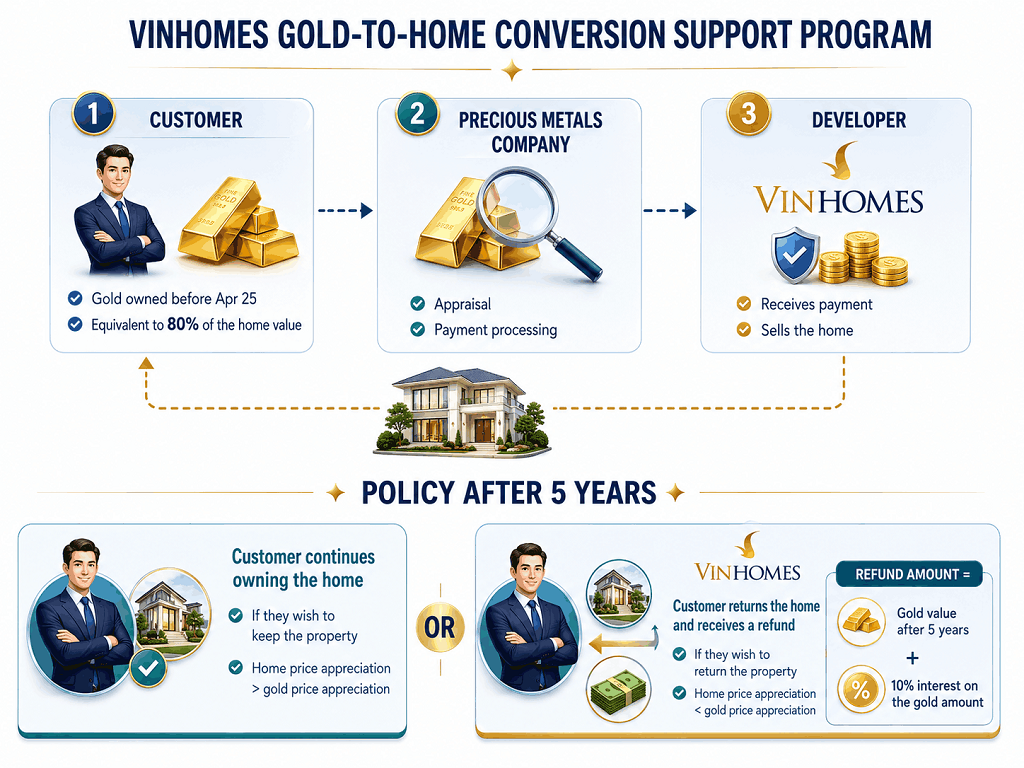
Essentially, this isn’t a gold-for-house exchange; instead, customers participating in the program will sell their gold outright at the price prevailing at the time of purchasing the Vinhomes property.
Vinhomes asserts that after 5 years, depending on the profit margin, customers can choose one of two options. First, they can continue to hold the Vinhomes property.
Second, if the customer returns the property, they can receive back an amount equivalent to 110% of the converted gold. In this second case – after 5 years, if the property value doesn’t increase as expected or the customer no longer needs the property – they can return the property to Vinhomes.
They will then be fully reimbursed for the initial amount of gold invested. In addition, customers will receive an interest payment equivalent to 10% of the gold. A Vinhomes representative confirmed that the company will refund customers “based on the gold price at the time after 5 years.”
During the 5-year period of home ownership under this gold exchange program, customers have the right to transfer the purchase contract or the house. The transferee will inherit the program. Vinhomes and the gold, silver, and gemstone companies will assist with all related procedures.
For example, in May 2026, Mr. Bac sells 50 SJC gold bars at around 160 million VND per bar to receive nearly 8 billion VND and buys a newly launched Vinhomes property in a project in Quang Ninh. By June 2031, seeing that the house price is not as expected, Mr. Bac chooses to return the house to the developer. Assuming the gold price rises to 200 million VND per bar, Mr. Bac will receive approximately 10 billion VND back, equivalent to the initial value of 50 gold bars at market price in June 2031. In addition, he will receive an interest equivalent to 10% of the converted gold, or about 1 billion VND. The total value of money that customers can receive back is 11 billion VND.
Vinhomes’ customer support program using gold to buy real estate could lead to two scenarios, according to expert Lam Minh Chanh, founder of the financial AI platform WikiMoney.
In the positive scenario, if after 5 years, the real estate price increases more than the increase in gold price plus 10%, buyers are likely to continue holding the property to benefit from this trend.
According to him, this is a “win-win” situation where people convert idle gold into income-generating assets, while businesses increase liquidity and affirm brand reputation.
In the opposite scenario, if the increase in house prices is lower than the increase in gold price plus 10%, customers will exercise their right to return the house to receive the equivalent value of gold and interest.
Mr. Chanh assesses that investors will almost not suffer any loss in this case because the asset value is preserved after 5 years and they also receive additional interest. “Real estate is currently acting as a hedge for them,” he said.
However, this financial expert believes that the company may face significant financial pressure. He estimates that Vinhomes could face actual capital costs (compound interest) of 13-14% per year to repay customers. He based this figure on an average annual increase of 11% in gold prices over the past 20 years. At this time, the sudden surge in capital costs will erode profits and directly impact the company’s earnings.
What expert Lam Minh Chanh is most concerned about is the risk of a “copycat” effect in the market. According to him, small and medium-sized enterprises (SMEs) may not have the same strong financial foundation as Vinhomes or Vingroup to withstand the significant capital pressure in the event of a real estate market downturn.
He also warned that businesses with weak internal resources or on the verge of cash flow depletion could exploit this method to save liquidity. These groups cannot borrow from banks due to legal obstacles in their projects, nor can they issue bonds because they struggle to meet stringent legal requirements.
According to experts, the lessons from previous corporate bond failures or condotel profit guarantees remain relevant, therefore caution is needed with new fundraising models involving people’s accumulated assets.
This new policy was introduced by Vinhomes amidst repeated government requests for the State Bank of Vietnam to find solutions to mobilize idle gold and foreign currency held by the public to serve the economy.
According to data published last year by the World Gold Council (WGC), Vietnam is among the highest gold consumers in the region – consuming an average of about 55 tons of gold annually. However, according to experts, the majority of this gold remains in people’s safes, a huge resource that has not yet been converted into capital for the economy.
Currently, Vinhomes is the largest real estate developer in the domestic market. This year, the company launched three major projects: Hai Van Bay (Da Nang), Global Gate Ha Long (Quang Ninh), and the International University City (Ho Chi Minh City).
From now until the end of the year, Vingroup could bring thousands of housing products to the market. The company has set a revenue target of VND 285,000 billion and a record consolidated after-tax profit of VND 60,000 billion for the whole year.