
Bac Ninh officially becomes the ninth centrally-run city
1 October, 2026

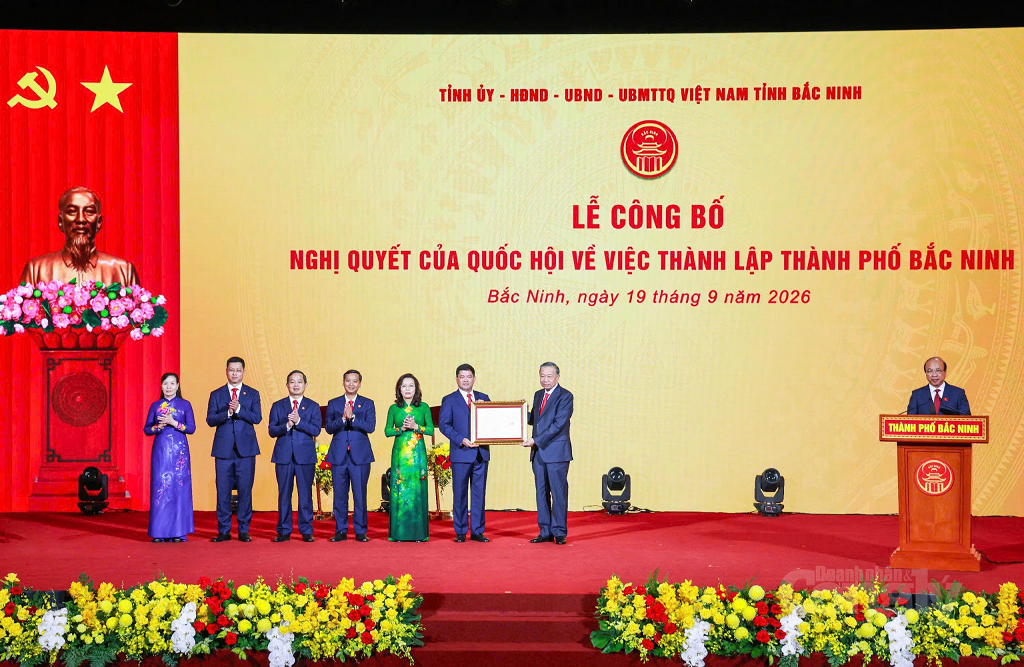
The National Assembly’s resolution on the establishment of Bac Ninh City officially takes effect on September 20, 2026. The new city has a population of nearly 4 million and comprises 99 communes and wards; documents bearing the designation “Bac Ninh Province” that have already been issued and remain valid may continue to be used in accordance with regulations.
On September 20, National Assembly Resolution No. 39/2026/QH16 regarding the establishment of Bac Ninh City officially took effect, making Bac Ninh the ninth centrally-run city in Vietnam.
The resolution was adopted by the 16th National Assembly during its first extraordinary session on August 24, 2026.
Under the resolution, Bac Ninh City was established based on the entire natural area and population of Bac Ninh Province. The city borders Hanoi, Hai Phong, Hung Yen, Lang Son, Quang Ninh, and Thai Nguyen.
According to the proposal submitted to the National Assembly, upon its establishment, Bac Ninh City covers a natural area of 4,713.75 km² with a population of 3,989,623 and comprises 99 commune-level administrative units, including 45 wards and 54 communes.
Consequently, as of September 20, Vietnam has nine centrally-run cities: Hanoi, Ho Chi Minh City, Hai Phong, Da Nang, Can Tho, Hue, Dong Nai, Quang Ninh, and Bac Ninh. Previously, Quang Ninh had officially become a centrally-run city on September 1, 2026.
A notable aspect of Resolution No. 39/2026/QH16 is the inclusion of transitional provisions designed to minimize disruption to the activities of residents, businesses, agencies, and organizations.
Accordingly, effective from the date the Resolution comes into force, agencies, organizations, and units currently bearing the name “Bac Ninh Province” shall be renamed to reflect the designation “Bac Ninh City.”
Regarding legal documents issued prior to September 20, 2026, any references to “Bac Ninh Province” therein—if such documents remain in effect after that date—shall be construed as references to “Bac Ninh City.”
Documents and papers related to “Bac Ninh Province” that were issued by competent authorities prior to the Resolution’s effective date—and which have not yet expired or reached the end of their validity period—shall remain valid and applicable until their expiration or until they are amended, supplemented, replaced, repealed, cancelled, or revoked in accordance with regulations.
This provision implies that the transition from a province to a centrally-run city does not necessitate the immediate, wholesale replacement of valid documents held by residents or businesses solely due to the change in the administrative unit’s name.
The Resolution also stipulates that, in addition to the regimes and policies applicable to centrally-run cities, the specific mechanisms, regimes, and policies previously applied to Bac Ninh Province shall continue to be implemented within Bac Ninh City until the end of their designated application period or until a competent authority issues a different decision.
In preparation for transitioning to a centrally-run city model, the locality took steps to refine its system of commune-level administrative units.
Under the plan submitted to competent authorities, 12 communes—Yen Phong, Tien Du, Chi Lang, Phu Lang, Luong Tai, Gia Binh, Nhan Thang, Hiep Hoa, Bo Ha, Lang Giang, Kep, and Luc Nam—are set to be upgraded to wards while retaining their existing administrative boundaries and population sizes. Following this process, the entire area will comprise 99 commune-level administrative units, consisting of 45 wards and 54 communes.
Public consultation regarding the proposal to establish Bac Ninh City was also conducted across all 99 communes and wards. According to a report by the Bac Ninh Provincial People’s Committee, 1,026,219 out of 1,035,707 households expressed their agreement, representing a 99.08% approval rate.
With a population of nearly 4 million and a land area exceeding 4,700 km², the new Bac Ninh City will encompass a much larger territory than the previous Bac Ninh urban area, incorporating regions from both Bac Ninh and Bac Giang provinces following the 2025 reorganization.

Alongside the restructuring of administrative units, the judicial system has been organized accordingly.
On August 24, 2026, the National Assembly Standing Committee issued Resolution No. 418/NQ-UBTVQH16 regarding the establishment of the People’s Court and the People’s Procuracy of Bac Ninh City. This resolution takes effect on September 20, 2026, coinciding with the city’s official establishment.
Prior to this, the Ministry of Public Security announced the decision to establish the Bac Ninh City Police, along with decisions concerning organizational structure and personnel; it also established police units for the 12 newly formed wards.
The synchronized organization of administrative and judicial institutions, as well as law enforcement forces, is part of the process of transitioning Bac Ninh from a provincial model to that of a centrally-run city.
The transition to becoming a centrally-run city takes place against the backdrop of Bac Ninh ranking among the localities with the largest economic scale in the country.
According to data reported by the Government during the proposal’s formulation, by 2025, Bac Ninh’s economic scale is projected to rank fifth nationwide and third within the Red River Delta region; its GRDP is expected to grow by 10.27%; it ranks second nationwide in attracting foreign direct investment; and its budget revenue is estimated to exceed VND 123.6 trillion.
Situated at the northern gateway to Hanoi, Bac Ninh offers connectivity to the Hanoi–Hai Phong–Quang Ninh economic triangle, Noi Bai Airport, and the Hai Phong seaport system. A new component of the locality’s development landscape is the Gia Binh International Airport, alongside the urban, industrial, and service zones taking shape around it.
The strategic direction established during the proposal’s development is to transform Bac Ninh into a modern, smart, green, and innovative high-tech industrial city, while continuing to advance sectors such as electronics, semiconductors, microchips, and artificial intelligence, and deepening its integration into global supply chains.
Alongside industrial development, a key requirement is the preservation of the cultural landscape of the Kinh Bac region. The new city area boasts a rich array of historical sites, festivals, and heritage assets, including Vinh Nghiem Pagoda, Bo Da Pagoda, Dau Pagoda, But Thap Pagoda, Phat Tich Pagoda, Do Temple, and the historical sites associated with the Yen The Uprising, the Victory of Xuong Giang, and the Hiep Hoa Safe Zone II.